Credit Unions

Full-service financial institutions that are owned cooperatively by their members.

The Cooperative Principles, the Common Good, and Solidarity

(EDITOR’S NOTE: This article emerged out of conversations Michael had with Terry Mollner and his thinking about creating institutions grounded in the idea the common good. Terry’s book, The Love Skill: We Are Mastering the 7 Layers of Human Maturity, explores these ideas in depth. It will be out in May of this year. He has written a lot on the Mondragon Cooperative experiment, which can be accessed at www.trusteeship.org).

Visions & Models: 
Practices, Tools & Strategies: 

IYC-Inspired Cooperative Moves

The International Year of the Cooperative is inspiring people in many ways. A month after the official UN declaration, cooperative organizations in Pittsburgh, including The East End Food Cooperative, Ujamaa Collective and those interested in starting cooperative organizations, gathered at The Big Idea cooperative bookstore for kick-off program.

Visions & Models: 
Practices, Tools & Strategies: 

Creating Democratic Education Resources for Building a Democratic Economy

Marketing Your Cooperative

What Steps Will You Take to Observe the International Year of Cooperatives?


Over the past year, staff of the National Cooperative Business Association has traveled the country talking with members and staff from cooperatives of all types, across all sectors of the economy. The topic has been how to take advantage of the marketing opportunity that is the International Year of Cooperatives. I’m writing here to talk about what’s being planned and what is available to cooperatives—but also to discuss the importance of marketing in and of itself.

Visions & Models: 

The Power of Cooperation

2012 – Not Business As Usual

Could Cooperatives Become the Fastest Growing Business Model?


Movements & Struggles: 
Practices, Tools & Strategies: 

Greece Develops Euro-Free Economy!

In the middle of the Greek monetary (Euro) crisis, people have discovered a way around the system that's been rigged against them. They are setting up local currency and exchange systems and doing business, effectively, without government money. The breathless story can be found at Raw Story and it is well worth reading and thinking about. But, for me, that's just the tip of the iceberg.

Move Your Money Campaign --Amy Goodman

Campaign Grows to Divest from "Too Big to Fail" Banks to Local Banks, Credit Unions...Saturday Nov. 5 set as "Bank Transfer Day"
Regions: 
Movements & Struggles: 

Credit Union Celebrates 25th Anniversary

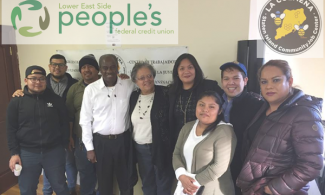
Lower East Side People's Federal Credit Union celebrates 25th Anniversary in New York City November 3rd
Institutions & Structures: 
Visions & Models: 
Practices, Tools & Strategies: 

Mondragon Training Journal - May 16, 2011: What's the Word on Mondragon

 Author's self-portrait outside of Mondragon headquarters.


Five of nine of us touring Mondragon arrive on Sunday in Bilbao, make our way to Mondragon-Arrastata, get settled and find food at the Monte bar a short walk from The Hotel Mondragon where we are staying for the week-long tour.  I fall into bed at about 10:30 (4:30 pm EST), the 12 hour journey and time zone change wearing me out.  Tonight there is no reading of The Kemetian Tree of Life, my nightly fix.   

Union leaders to pull funds from five banks, look to CUs

report from Credit Union National Association
Institutions & Structures: 
Movements & Struggles: 
Practices, Tools & Strategies: 

What should our movement look like in 2040?

Where will our movement be in another 30 years? In 2040, I will be 76 years old. Chances are, if I am still alive, I will be hopefully still be blogging (or whatever the kids will be doing in those days) but I will likely not be fully involved in the movement or physically working a 40-50 hour work week. Almost all of our current leadership will be in the same position. The current crop of  Toxic Soil Busters will be pushing 50 (like I am now). What should our movement look like in that age?
Regions: 
Movements & Struggles: 

Mondragon Diaries: Day Five

Our first stop is another component allied with Mongragon University called SAIOLAN. It's an incubator project for helping to launch new coops and high-tech businesses as well as training new entrepreneurs.
Regions: 

Mondragon Diaries: Day Four

Most new small businesses fail. That's a fact, whether they are in the Basque Country or in the U.S. Or anywhere else. Yet the Mondragon Coops, which all started as small worker-owned businesses, have hardly ever failed. Why? The key is in Father Jose Maria Arizmendi's original founding conception of cooperatives as the interlocking of school, factory and credit union.
Regions: 
Movements & Struggles: 

Mondragon Diaries: Day Three

Our topic this morning is the wider range of the cooperative movement, both in the Basque Country and Spain. Mondragon is a part of the Basque Cooperative Confederation. There are currently 755 cooperatives in the Basque Country, and only 80 of them are the worker-owned MCC coops. There are a total of 537,000 members of all the coops, but only 54,919 are worker members, and 37,860 of these are the MCC worker-owners. 

Regions: 
Movements & Struggles: 

Mondragon Diaries: Carl Davidson's Five Days Studying Cutting-Edge People and Tools for Change

I'm with a group of 25 social activists on a study tour organized by the Praxis Peace Project. Our focus is the Mondragon Cooperative Corporation, a 50-year-old network of nearly 120 factories and agencies, involving nearly 100,000 workers in one way or another, and centered in the Basque Country but now spanning the globe. We're here to study the history of these unique worker-owned factories, how they work, why they have been successful, and how they might be expanded in various ways as instruments of social change.
Regions: 
Movements & Struggles: 

Co-ops Unite to Support Worker-Ownership in Home Care

by Jim Johnson, GEO Collective

Past issues of GEO have reported on the emergence of a particular type of worker cooperative, the home care cooperative. In the 1980s, the federal government followed the lead of state governments like Wisconsin and acknowledged that elderly and disabled people who need help in day-to-day living are best served by in-home assistance. Medicare and Medicaid funding that would have otherwise been used only for nursing homes would now be applicable to home care services.

Regions: 
Practices, Tools & Strategies: 

A Participatory Credit Union for Worker Cooperatives

By Ajowa Nzinga Ifateyo

Credit: www.fao.orgIn order to compete in a corporations-dominated economy, worker cooperatives need millions of dollars to finance large-scale businesses in manufacturing and production.

Regions: 
Practices, Tools & Strategies: 
Subscribe to RSS - Credit Unions