
This article was originally published in Shelterforce, a national nonprofit publication covering housing. Sign up for their newsletter here.
Mondragón has always thought that our main purpose is to do business, and [that] the way we get social transformation [is] through business, and that’s still true. But that’s not enough.
—Ibon Zugasti, international project manager at LKS Cooperative
In many respects, the 70-year track record of the Mondragón Cooperative Corporation, the world’s largest worker co-op network, is inspiring. It is common to think of worker co-ops as marginal and small. But as of 2024, Mondragón had 81 member co-ops and 12 research centers, and reported revenue of 11.2 billion euros (around $12.7 billion). It is the fifth-largest private-sector employer in Spain, providing jobs to 70,085 people in 2024. In 2025, revenue climbed modestly to €11.3 billion and employment rose to 71,415 people.
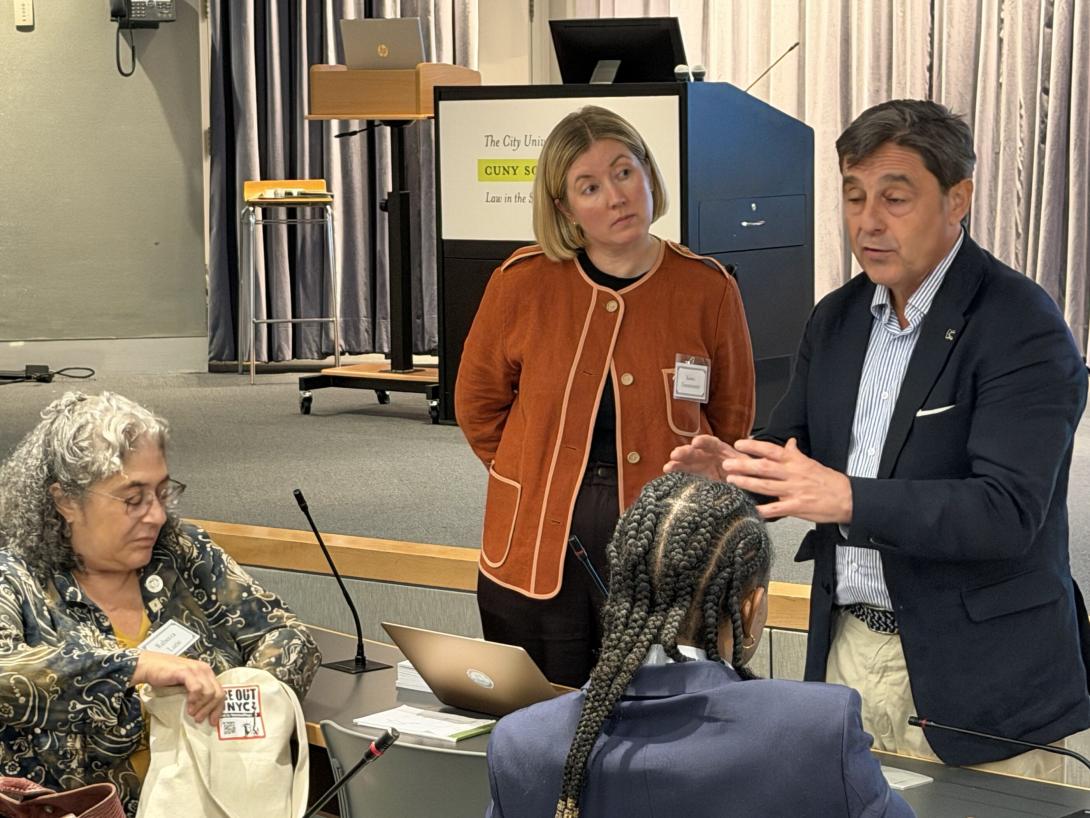
But at a series of capacity-crowd events held in New York City and Boston at the end of May, the three Mondragón leaders visiting those cities weren’t there simply to promote their model. Rather, they were making the case for building a broader, indeed global, network centered on cooperation, social economy, and solidarity. As Iñigo Albizuri Landazabal, global head of public affairs at Mondragón and director of Arizmendiarrieta Social Economy Think Tank (ASETT), puts it, “We need to cooperate with others. … If we want to maintain our cooperative experience, we need others.”
The trip aimed to build the ASETT network, established by Mondragón, Basque regional government agencies, and nongovernmental allies. The group held its inaugural conference in Spain in May 2025, attended by 500 people, and is planning a second conference this November.
ASETT’s mission is to promote the concept of a social economy. The European Union (EU) defines the social economy as a set of community-owned institutions, including cooperatives, that operate by “putting people first, producing a positive impact on local communities and pursuing a social and/or environmental cause.” The EU estimates that the social economy accounts for 6.3 percent of employment in the EU. In Spain, Ibon Zugasti, international project manager at LKS Cooperative (also known as LKS Next), an 850 worker-owner consultancy co-op that he describes as the McKinsey of the Mondragón network, says the figure is closer to 10 percent, but adds that “getting 10 percent of the economy is not that good. [It] should be [that] 90 percent is the good part.”
What Is Mondragón?
Mondragón has long been held up as an international exemplar. It was even the subject of a British Broadcasting Company documentary in 1980, broadcast the year after Britian’s famous strike-laden winter of discontent, in part to show how worker-management conflict might be transcended by empowering workers to directly control companies. More recently, in 2022, a New Yorker profile touted Mondragón as offering a possible “alternative future for capitalism.”
“Over the years, Mondragón grew into one of the world’s largest networks of worker-owned cooperatives, with businesses spanning industries such as aerospace, elevators, bicycles, and wind turbines,” explains Niloufar Khonsari, former worker co-op co-owner and immigrant rights lawyer, in The Future Is Collective. “The cooperative operates with salary caps for executives and equal voting for worker-owners on key decisions, and it shares resources across co-ops during tough periods.”
As with most worker cooperatives, workers must buy shares to become worker-owners; according to a Guardian report, as of early 2024, the price was €17,000. Shares can initially be bought with a loan from Mondragón’s bank, with the purchase paid off through payroll deductions over time. In Spain, nearly all employees of Mondragón cooperatives are worker-owners, except for those at major supermarket chain Eroski, which has a hybrid consumer-worker ownership structure. Its scale of more than 1,000 stores (and high turnover rate) has led to only one-third of workers becoming co-owners.
Mondragón’s salary cap rule mandates that the highest-paid manager earn no more than six times what the lowest-paid full-time worker earns—compared with a ratio of 344-to-1 in the U.S., according to the Christian Science Monitor. The co-op not only practices democratic management but, as a Wharton business school report notes, maintains a “democratic process for strategic planning.”
Mondragón is organized into four main branches: industrial production (the overwhelming majority of member co-ops); education and knowledge; retail/distribution (including Eroski); and finance (including Laboral Kutxa, a major bank with over €23 billion in assets). Mondragón is also profitable; its 2024 annual report touted “record profits” of €632 million. In 2025, profits were slightly lower at €618.8 million. As co-owners, workers at the co-op share in profits. The rest of the profits are retained by the co-op businesses themselves, with 10 percent dedicated to supporting social and cultural projects.
How Mondragón Came to Be
Mondragón has an unusual origin story. It began with a Catholic priest, José María Arizmendiarrieta, who narrowly avoided execution by fascist forces during the Spanish Civil War. In the early 1940s, Arizmendiarrieta became a priest at a church in the small town of Mondragón in Spain’s Basque Country, near the French border. At the time, the town had a population of a little more than 8,000 people. (Today, the population has grown to a little over 22,000 people.)
The Basque Country was devastated during the Spanish Civil War. Guernica, which was carpet-bombed in April 1937—a war crime made famous by the painting of Pablo Picasso—is less than 30 miles from Mondragón. The fascist regime of Francisco Franco, which lasted from 1939 to 1975, prohibited the use of the Basque language in public.
In 1943, amid this highly oppressive environment, Arizmendiarrieta founded a polytechnical school that later became Mondragon University. In 1956, five graduates of the school jointly founded Mondragón’s first worker cooperative.
A dozen years later, the network of cooperatives had grown to more than 6,000 worker-owners, and the co-op network had become a leading producer of washing machines, car parts, and other industrial products sold throughout Spain and later internationally.
Today, Mondragón operates throughout the world, “with 104 production plants in 37 countries, commercial business in 53, and sales in more than 150.”
Why Mondragón Aims to Build New Alliances
Mondragón offers a powerful model for equitable distribution of profits and wages, democratic management, and more. This does not mean the network is without challenges. As a former Mondragón official liked to emphasize, “This is not paradise and we are not angels.” For example, an ongoing area of tension in the Mondragón model is that workers outside of Spain are treated as employees and not given the opportunity to become worker-owners. Why this is the case is subject to dispute. Jill Bamburg, a U.S. business professor, writes that the most compelling reason given to her “is that there is not a culture of cooperatives in these foreign markets and Mondragon does not believe in, or have the capabilities for, proselytizing the cooperative form.” But she concedes that “it might also be against [current worker-owners’] economic interest to include more worker-owners in the confederation.”
ASETT has three main objectives. One is to build for the future, which involves engaging in scenario planning. The second is to pilot and scale cooperative and social economy practices. And the third is to focus on knowledge generation and transfer to create a narrative that breaks down Mondragón’s isolation and builds support for a social and solidarity economy.
One obvious challenge for Mondragón is ensuring continued employment for future generations. Although Mondragón employment climbed between 2024 and 2025 to just over 70,000, it is still lower than it used to be. In 2017, Mondragón reportedly had more than 80,000 employees. However, in 2022, members of two co-ops with a total of 11,000 workers voted to leave the Mondragón network, thereby eliminating their financial obligations to the network (but remaining worker co-ops themselves) and reducing the number of employees in the network. Going further back, a 2009 estimate placed total employment at nearly 100,000 people.
This employment decline was partially driven by the 2013 demise of Fagor Electrodomésticos, once Mondragón’s flagship co-op and main appliance business. At the time of its closure, 5,600 employees worked at the co-op—and some Mondragón workers protested, saying Mondragón’s bank should bail out the enterprise.
Ultimately, Albizuri emphasizes, the cooperative network enabled all the laid-off workers from Fagor to find employment in other cooperatives as positions became available (for example, by backfilling roles as other workers retired or otherwise left their jobs). But closing the company was hard—it involved shifting the network’s identity away from the specific activities of its companies and toward ensuring there was work for its members. It was, Albizuri explains, “very hard to admit … that we were people, not companies.”
This logic now informs Mondragón’s thinking. “What is important is the jobs and the people, and not exactly which … business you are working in now,” Albizuri says. “We come from a very traditional industry: metal industry, stamping, forging. … But the world is changing so fast. … We are trying to think [about] new positions in health, in the care economy.”
For Zugasti, finding new sources of employment as legacy businesses shrink is imperative. While some worker co-op advocates contend that worker co-ops provide a path to avoid growth pressures, Zugasti disagrees, arguing that “if you want to create new jobs, you always need to look for new markets, new value propositions, new sectors.”
To meet new market niches and needs, Albizuri says Mondragón needs to build alliances with other cooperatives around the world. He says the goal is to “connect with other cooperatives and social economy companies [to] do business with them and try to move [politically] together.”
To date, ASETT has built a broad coalition to advance policies and practices that support businesses motivated by purpose rather than profit. In addition to government allies at the regional and national levels, the coalition includes groups such as Gureak (a Basque organization comprising businesses that seek to employ people with disabilities), the Council of Cooperatives of the Basque Country (Kooperatiben Kontseilua), the Spanish Social Economy Employers’ Confederation (CEPES), and allies from across the world (including the U.S., Latin America, Africa, and Asia).
Mondragón leaders hope the ASETT network will help them learn about models—including housing models—advanced by other cooperative movements. Kaisu Tuominiemi, a Finnish educator who leads the Traveling University program at the Mondragon Team Academy, emphasizes that one of Mondragón’s priorities during its visit to New York City was to learn about affordable cooperative housing models—such as those supported by the Urban Homesteading Assistance Board—so it can launch pilot programs in the Basque region.
“Affordable housing is really becoming a challenge … especially for the youth, as they don’t have the same opportunities that maybe their parents or grandparents have. So, this is something that we are discussing … and starting to work [on],” Tuominiemi says.
Albizuri notes that Article 17 of Spain’s Constitution establishes a specific “right to housing,” even if enforcement is highly imperfect. He adds that in Spain, especially around Barcelona, there are already some initiatives “to build social housing in a cooperative way.”
Perhaps ASETT’s most ambitious goal is to shift the overall narrative about the economy from one that focuses on money and profit to one that focuses on principles and purpose. In doing so, Mondragón, rather than being an outlier in a capitalist world, would become the norm, with principles of—open membership; democratic organization; sovereignty of labor; the subordinate nature of capital to workers; worker participation in management; wage solidarity (limited variation of salaries from leaders to workers); cooperation among cooperatives; and commitments to social transformation, economic democracy, and member education—incorporated into cultural values and public policy. Mondragón’s principles resemble in many respects the seven international cooperative principles, but some of them—such as wage solidarity, the subordination of capital to workers, worker participation in management, and a commitment to social transformation—extend well beyond international cooperative norms. All of this is captured in Mondragón’s motto: Humanity at Work.
Zugasti recalls a 2019 global summit held in Brazil, attended by leading think tanks from across the world to discuss geopolitics, business, and public policy.
“Nobody was talking about us,” he says. In their worldview, “We don’t exist.”
“We want to own not only our works but our own narrative,” says Albizuri. “That is [a] very important thing because for years we have done nothing about this. … We want to propose to governments different [types] of public policies.” In other words, Albizuri and his ASETT allies are seeking to elevate narratives and policies that support the principles Mondragón has pursued for decades.
“We strongly believe that [the] more cooperatives we have … the better societies we’re going to have,” says Albizuri. “We always say that cooperatives are schools of democracy.”
Add new comment