
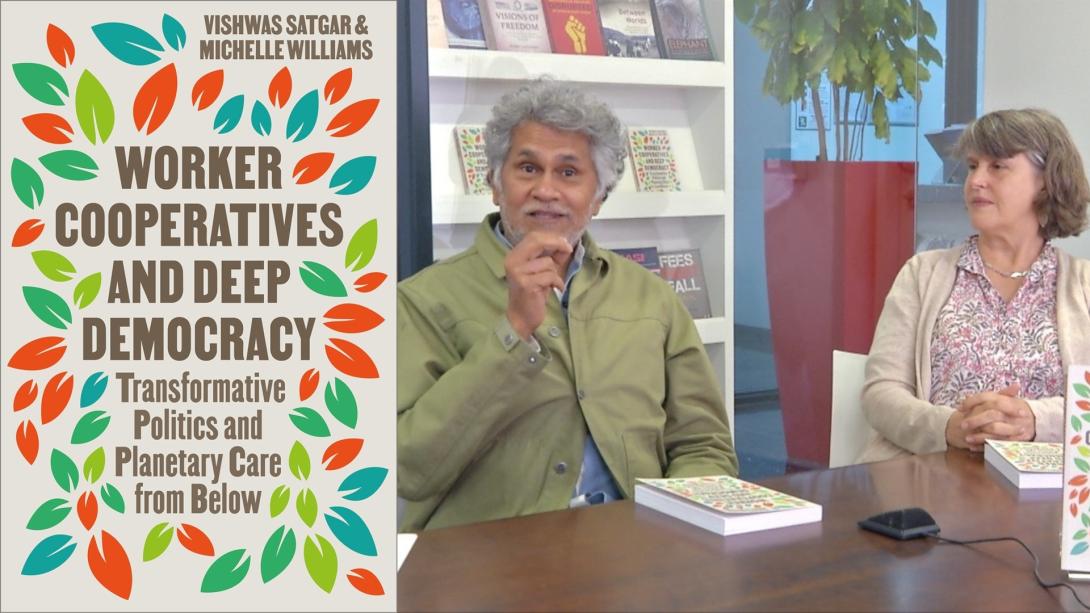
[Editors note: PolitySA has posted a 40 minute long interview with Satgar and Williams on their YouTube channel.]
Those of us who promote not only the significance of utopian visions, but their necessity, are familiar with the eyerolling of skeptics and the guffaws of “practical people” who adamantly refuse and totally disdain the notion of “blue sky thinking.”
At moments like that I recall the many conversations I have had when discussing the management of the commercial, union-affiliated, worker cooperative print shop where I was a member. “The 16 members met to run all aspects of the shop,” I would say. And the response was invariably disbelief. “How could that work?” To my interlocutor it was unbelievable, unimaginable, it was utopian.
The unique communities described in great detail in the recently published Worker Cooperatives and Deep Democracy, authored by two South African academics, are utopian, in the sense that my worker cooperative seemed as such. They are utopian in vision, but thoroughly practical in their everyday functioning. The authors state, in fact, that a coherent founding vision is vital for an enterprise to endure.
So where are these utopias?
Where they exist may come as a surprise since they aren’t necessarily in the most affluent countries. The authors, Vishwas Satgar and Michelle Williams, devoted well over a decade to accomplish their in-depth research. They visited 15 countries and conducted 368 interviews with members of 146 worker cooperatives and solidarity economy-based cooperative systems. They often returned to locations to gage the evolving social dynamics. (I met them in 2008 on their first visit to California.)
In their travels they witnessed a diversity of projects that transformed extractive economics by creating a common benefit economics embedded with values of democratic participation, care, and ecological sensitivity. The insights of the participants arose from their real-world experiences, not from ideals promulgated by movements or political parties. A new subjectivity materialized in the daily lives in this way, that is, a new culture formed – one that contended with the old hierarchical and miserabilist one and superseded it.
The worldwide cooperative economic sector is huge by any standard. The International Cooperative Association (ICA) estimates that there are one billion members of 300 million cooperative entities. Many people belong to more than one co-op, for example, a member of a food co-op may belong to a credit union and a utility co-op.
While the sector may be large, the number of cooperative enterprises that challenge capitalism based on the lived values of cooperation, as commoning, is relatively small. However, when these co-ops are allied with solidarity economic-based projects, or, in a few situations, with state sponsored support they have a magnified influence.
Satgar and Williams depict the Brazilian Solidarity Economy Forum as an example of a project initiated by the mayor of Sao Paulo in the late 1990s to assist 1.6 million unemployed residents. An academic suggested an alternative currency to facilitate production and consumption cooperatives formed by the residents. This project attracted the help of local charitable organizations and the Forum was established to create a network to assist the self-help initiative.
With Lula’s election the government furthered the Forum’s work. Today the Forum and the organized cooperative sector in Brazil collaborate to provide healthcare, financial services, and ecological assistance throughout Brazil in a conscious endeavor to challenge the social failings of capitalism.
The authors’ exploration of the Uralungal Labour Contract Cooperative Society (ULCCS) in Kerala, India revealed the depths of its influence in the society and the breath of its scope. The cooperative is a one-hundred-year-old construction company with 2,000 members. It builds roads, bridges, and large building complexes such as hospitals. Over the years it demonstrated to a series of government the viability of democratic management that prioritized the workers’ needs, which in turn meant quality work. The result has been major state contracts for infrastructure development.
ULCCS’s concern for their members extends to their families and to the community at large. Embedded in the community, the “deep democracy” referred to in the title of the book, means that it has been instrumental in developing a caring culture amongst the membership and, more significantly, beyond to the wider society.
Another cooperative with strong community support, featured in Avi Lewis and Naomi Klein’s Argentine documentary The Take, is the Buenos Aires printshop Chilavert. Chilavert was one of the hundreds of recovered factories during the Argentine economic crisis at the beginning of the 21st century. When the authorities at the bidding of the owner blockaded the workers inside to starve them out, a property owner next door broke open a hole in their adjoining wall and neighbors fed the workers until the blockade was finally lifted.
Chilavert, now back in business, abandoned its old cliental and sought contracts with businesses and groups aligned with its anti-capitalist perspective. In the evenings the shop is open for classes and community meetings and on the weekends in becomes a venue for music.
ULCCS and Chilavert are examples of cooperatives extending the ethic of the commons within society. Satgar and Williams also describe cooperatives that develop community relations based on the natural commons: Cecoseola in Venezuela, Heiveld in South Africa and Trentino in Italy.
Each of these cooperative institutions created economic enterprises that depended on the natural world, and not in the capitalist extractive sense that commoditizes abundance into scarcity for profit. The cooperatives make use of these same resources to cultivate them for extended use integral to their operation.
Central Cooperativa de Servicios Sociales del Estado Lara (Cecosesola) is a cooperative network in a more remote area of Venezuela. Venezuela imports much of its food, however Cecosesola, with its 50 cooperatives and 20,000 members, manages to distribute agricultural products, process them, and distribute the food to over 60,000 families in the region.
Over its five decades Cecosesola has expanded commoning beyond agriculture to incorporate credit unions, a bakery, a transport system, local clinics and a hospital and it even offers insurance. The cooperative network, with its dense web of solidarity relations makes it possible to pursue an anti-capitalist logic with human-centered economic activity. Cecosesola was recognized worldwide in 2022 when it was a joint winner of the Right Livelihood Award.
Another agricultural cooperative centered in the rugged rooibos tea-growing Northern Cape province of South Africa. Founded only twenty-five years ago, it has become world renowned for its organic tea grown naturally in this area. The tea is commercially grown elsewhere with the chemically saturated methods of corporate agriculture.
To maintain the integrity of their fair-trade tea, Heiveld supports the financial independence of their 64 farmer members, many of whom are women. The cooperative therefore plays a major role in maintaining gender equality.
During a three-year drought the cooperative realized that it had to contend with climate change by developing an appropriate response strategy. Heiveld connected to several progressive NGOs to monitor weather patterns and later it reached out to agricultural researchers at the University of Cape Town. Integrating agricultural science with their experiential and traditional knowledge helped them adapt to climate change.
Heiveld has managed to align its democratic practices, which reveal social sensitivity, to the care they approach their fragile environment. Nature is not “out there” but deeply connected to the life of the community.
The authors of Worker Cooperatives and Deep Democracy emphasize the democratic aspect of their book with an excursion to one of the few places they highlight in Europe—the province of Trentino in northern Italy. The Federation of Trentino Cooperatives comprises nearly 600 cooperatives in 223 villages with approximately 270,000 members, which is about half the population of the entire province. There are members in worker cooperatives, as farmers, as retailers, and as bank staff. The whole network is managed by 5,400 administrators in the individual co-ops and in the federation. The province abuts the Alps, and the town squares of mountain villages are the center of economic activity where you will find a cooperative selling the food produced in the province.
The diversity of the agricultural produce, coupled with the dairy farms, and the animal husbandry — all within cooperative networks — has raised the economic status of what was previously a poor province and is now ranked in the top spot in the Italian 2025 Quality of Life Index. This ranking is not simply an economic barometer; it also calibrates the values of tolerance and conviviality. Further, the democratic values of the cooperatives have influenced the local government to be responsive to citizen participation.
It was only possible in this review to very briefly mention some of the worker cooperative ventures that Satgar and Williams spend pages analyzing as evidence that democratic workplaces, coupled with solidarity economy collaborations, are creating oppositional cultures to the dead-end prospects of capitalism.
What they survey are not “pie-in-the-sky” fantasies, or blueprints to follow, but “intentional, conscious and positive solidarities resisting the encroachments of an avaricious capitalist system…”
Worker Cooperatives and Deep Democracy depicts places where people have organized for themselves, for their own benefit, and in doing so are building a quality of life in the present that fortifies them to meet the challenges of dire times ahead. Reading it is exhilarating and at the same time it’s obvious that in the United States we have a mighty organizing project ahead of us. It may seem overwhelming.
The cooperative US economy, if you count the agricultural, finance (credit unions), housing and retail sectors, is not insignificant, however it pales in comparison to the capitalist behemoth. The gross worth of the sector isn’t as important as the geographic locations of the cooperatives. There are cities and towns where cooperatives are concentrated and if networked with each other and solidarity economy groups a dynamic social movement could develop. And a movement is taking form in several US geographic areas like the Rust Belt, the Northeast (including NYC) and the West Coast federations exist, and the South has a viable potential with new worker cooperatives forming.
The unknown here is how quickly our socio-economic reality will strain beyond repair due to economic speculations gone awry, wars, political corruption, or the inevitable serial climate catastrophes and increasingly depleting resources. There are few social institutions to draw upon to ameliorate any of these disasters. Isn’t it time to begin to look around at what already exists that adheres to the values of cooperation?
Citations
Bernard Marszalek (2026). Book Review: Worker Cooperatives and Deep Democracy. Grassroots Economic Organizing (GEO). https://www.geonewsletter.org/articles/book-review-worker-cooperatives-and-deep-democracy
Add new comment